
The acceptance of offer process
At this stage of the process, if we ask parents to sign their acceptance of an offer of enrolment. Ordinarily, both parents are required to sign their acceptance.
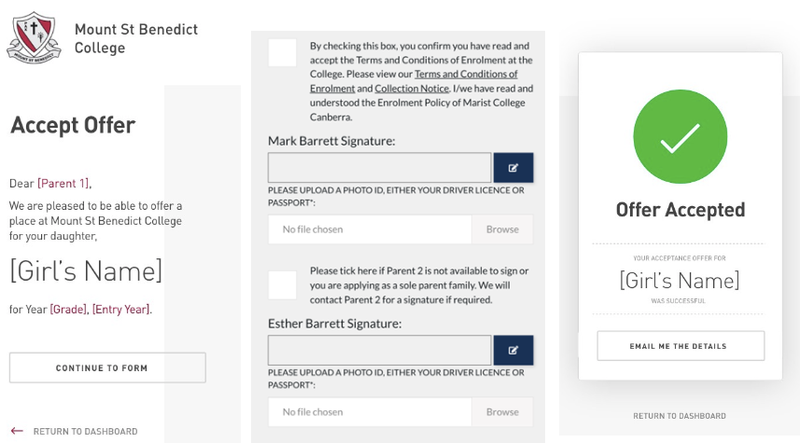
The Accept Offer form is only available from an email link or the user parent’s dashboard. This is the parent who has completed the initial application. In both cases, the user parent has to login using their credentials.
Parent 1 (user parent) will click on the Accept Offer link on their dashboard, which will send an email to Parent 2 (non-user parent) with a request to accept the offer. The email address for Parent 2 was provided in the enrolment form and can only be changed by staff. Parent 2, for security reasons, does not see any of the data that has been authored by Parent 1 in the Application. They are presented with a form of identify verification by providing their last name, email address and their child's date of birth. When Parent 2 has signed, a system generated email is sent to Parent 1 advising them that Parent 2 has signed and requesting their return to their dashboard to complete the process.
On submission, we collect the following:
- A digital footprint shows that the user is logged in and is completing the Accept Offer form as that logged in user (ie user must have access to the email address).
- All information including the Terms, Data Collection Policy and the Form (including screenshot of the Agreement page) as a collated PDF are emailed to the School and the parent(s) on submission.
- The specific and unique IP addresses of both computers which were used to complete the signing.
- The timestamp of the submission.
- The reconciled payment / banking information via their credit card linked to their unique id.
- A signature - ie Parent/Carer actually signs the agreement.
- Either a copy of the Parent/Carer's Passport or Driver's License (optional).
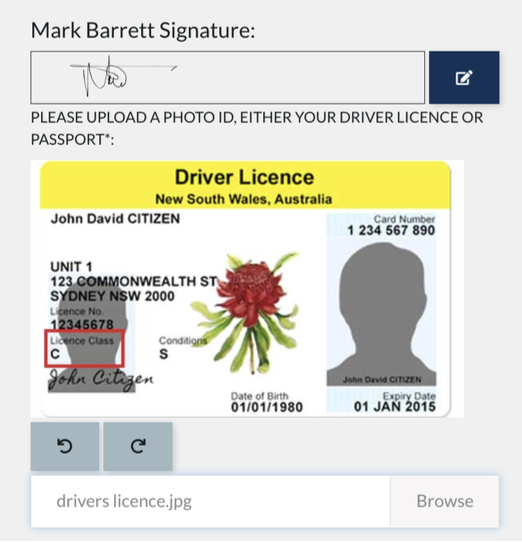
Example of IP Address and Time Stamp:
This collection of information constitutes a digital signature - not just an electronic signature - as hidden data is attached to the form to prove the authenticity of the author and their intent to sign.
The application for enrolment form
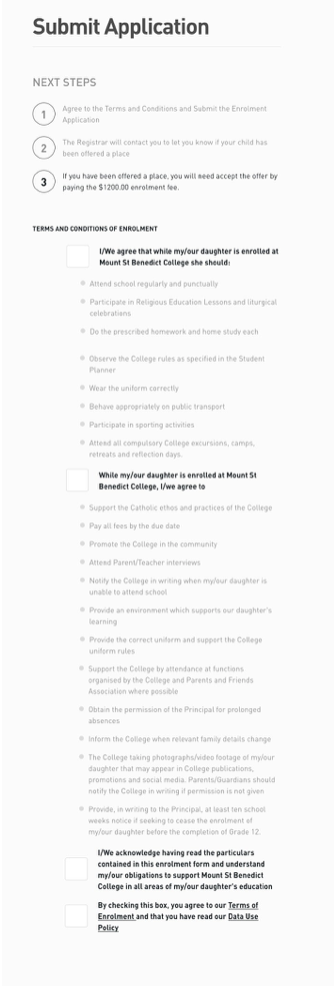
The picture below shows an example layout of an application for enrolment form.
A parent has to create an account/profile (or verify an account we create for them), complete the form and make payment, showing consideration and intent to enter into a contract with the school.
On submission, we collect the following:
- A digital footprint showing that the user is logged in (after verifying their email address) and is completing the Application Form as that logged in user. (ie user must have access to the email address)
- All information including the Terms, Data Collection Policy and the Form (including screenshot of the Agreement page). This form is collated into a PDF and emailed to the School and the parent on submission.
- The specific and unique IP address of the computer used to complete the application.
- The timestamp of the submission.
- The reconciled payment / banking information via their credit card linked to their unique id.
- A signature - ie Parent/Carer actually signs the agreement.
- Either a copy of the Parent/Carer's Passport or Driver's License (optional).
This collection of information constitutes a digital signature - not just an electronic signature - as hidden data is attached to the form to prove the authenticity of the author and their intent to sign.
Common questions
Are Electronic Signatures Legal in Australia?
E-signature is now a widely accepted form of finalising an agreement. As companies and countries alike work to become more quick, streamlined, and connected, working digitally is one of the key ways of doing this. The Electronic Transactions Act
1999 (ETA) in Australia was the government’s commitment to providing online availability where possible, and ensuring electronic signatures are considered valid in the eyes of the law.
What are the legal requirements of the ETA?
The ETA is considered what is known to be a “permissive” or “minimalist” law, meaning that it is virtually an “anything goes” sort of law. In Australia, there are very few laws governing the actual use of electronic signatures—they are simply accepted. Nearly all documents are permitted to be signed electronically.
There are some exceptions—the Act applies to all laws except for some specific exemptions outlined in the Electronic Transactions Regulations 2000. These include documents regarding migration and citizenship, wills, powers of attorney, and some real estate transactions in certain areas of the country. A typical business transaction, however, includes none of these restrictions, making e- signatures an acceptable execution.
The acceptance process and security protocol
EnrolHQ asks parents to accept the Terms of Enrolment twice in the application process.
- When the Application for Enrolment is first submitted and
- When an Offer of Place is accepted.